
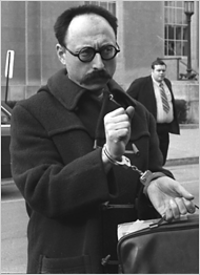
I knew of Ralph Ginzburg and Eros Magazine because I went to elementary school with his son. My sixth grade class wrote a letter to the editor of the New York Times in support of him. He died yesterday. This is from his obituary in today’s New York Times. No surprise, Ginzburg was born in Brooklyn.
Ralph Ginzburg, a taboo-busting editor and publisher who helped set off
the sexual revolution in the 1960’s with Eros magazine and was
imprisoned for sending it through the United States mail in a case
decided by the Supreme Court, died on July 6 in the Riverdale section
of the Bronx. He was 76.
Ralph Ginzburg wore handcuffs outside the federal building in
Lewisburg, Pa., in 1972 as he was being taken to federal prison.
The cause was multiple myeloma, a cancer of the bones, said Shoshana Ginzburg, his wife and collaborator of 49 years.
First published in 1962, Eros was a stunningly designed hardcover
"magbook" devoted to eroticism. While Playboy and other men’s magazines
of the time catered mostly to male fantasies, Eros (named for the Greek
god of love and desire) covered a wide swath of sexuality in history,
politics, art and literature. Mr. Ginzburg valued good writing, and his
contributors included Nat Hentoff, Arthur Herzog and Albert Ellis. – New York Times Obit
Eros also challenged the taboo of interracial love in a photo essay by Ralph M. Hattersley Jr. and published a previously suppressed portfolio of nude photographs of Marilyn Monroe, taken by Bert Stern.
Mr. Ginzburg’s eventual conviction on the obscenity charge hinged not on the content of his publications but on their promotion. The Supreme Court held that if "the purveyor’s sole emphasis is on the sexually provocative aspects of his publications," that could justify a finding of obscenity for content that might otherwise be marginally acceptable.
Born in Brooklyn on Oct. 28, 1929, to immigrant parents from Russia, Mr. Ginzburg studied to be an accountant until his professor at City College encouraged him to accept an editorial job on the school newspaper, The Daily Ticker. With a passion for journalism, he took a job after graduation as advertising and promotion director at Look magazine and later became articles editor at Esquire.
Mr. Ginzburg soon found he had a talent for the mail-order business, especially writing attention-grabbing promotional advertisements. He wed his business and publishing instincts to social activism.
His first self-published book was "100 Years of Lynching," a compilation of newspaper accounts that exposed American racism. Later he published "An Unhurried View of Erotica," about the secret caches of erotic material in some of the world’s most famous libraries.
Eros, which was sold only through the mail, was conceived in a hardcover rather than a softcover format as a marketing ploy to extract a hefty cover price. Mr. Ginzburg hired the leading mainstream advertising typographer/art director, Herb Lubalin, to create innovative layouts for Eros. It cost him a lot of money to produce and never rose out of the red.
When the fourth and final issue appeared (a fifth was prepared but never published), Mr. Ginzburg was indicted on charges of violating a federal statute that regulated obscene advertising. His publications (Eros; Liaison, a biweekly newsletter; and "The Housewife’s Handbook on Selective Promiscuity") were deemed obscene "in the context of their production, sale and attendant publicity." After various appeals, the case was argued before the Supreme Court in 1965, and in 1966 Mr. Ginzburg’s conviction was upheld.
Despite protests by First Amendment advocates, he served eight months in a federal prison in 1972 after the Supreme Court refused to hear an appeal of his sentence.
His book "Castrated: My Eight Months in Prison" (a short version of which was published in The New York Times Magazine) was dedicated to his wife and collaborator.
As to why Eros was considered obscene, Mr. Ginzburg wrote in the book, it was a mystery to him. " ‘Obscenity’ or ‘pornography’ is a crime without definition or victim," he said. "It is a bag of smoke used to conceal one’s own dislikes with regard to aspects of sex."
The Eros case was just one of Mr. Ginzburg’s famous run-ins with the courts. In 1964 another of his iconoclastic magazines, Fact, a political journal with a muckracking bent (and the first to publish Ralph Nader when he was a Harvard student), published a special issue on the "Mind of Barry Goldwater" when Senator Goldwater was the Republican presidential candidate that year, claiming that he was psychologically unfit for the office. Goldwater successfully sued him for defamation all the way to the Supreme Court; Justices Hugo L. Black and William O. Douglas dissented, citing issues of free speech. For Goldwater, it was a Pyrrhic victory; he received only $1 in damages.