OTBKB Music: Useful Lists and A Video

A couple of useful lists are waiting for you over at Now I’ve Hear Everything: music venues in Brooklyn and Lower Manhattan (provided by radio station WFUV to celebrate the fact that with changes to their antenna, the station can now actually be heard in those places, including Park Slope) and a calendar for this week which highlights many good but conflicting performances.

If that’s not enough, how about a video of John Hiatt and his top notch band performing the title track from his new album, The Open Road?

–Eliot Wagner

What To Do With The Food Coop Profits

It’s a good problem to have. The Food Coop is making a ton of money — to the tune of $39 million a year, and profits of $500,000. So what should they do with the profits. Lower the prices, start other coops, give it away?

An article in Crains NY reports on this problem. Here’s an excerpt.

The first sign that Brooklyn’s Park Slope Food Coop is unlike any other supermarket in the city are the people milling outside wearing orange-and-yellow vests. Their task is to accompany shoppers on walks home with their groceries—and then return the shopping carts to the Union Street store.

It is a job that reflects the mission of the co-op to cultivate a sense of community, but it also helps solve a growing problem for the organization: finding enough stuff to do for the nearly 16,000 members who must work 2.75 hours for the co-op every four weeks in order to shop there.

Founded in 1973, the Park Slope co-op has grown so dramatically in recent years that it has been forced to limit the number of new members. Its balance sheet is so strong—the co-op paid off its mortgage in January—that general manager and founding member Joe Holtz wonders what to do with more than $500,000 in profits. Last year’s revenues were $39 million.

“If we continue to accumulate cash like this,” he says, “we’ll have to have a meeting and maybe lower our prices again.”

For the first time in its history, the co-op is confronting the fact that it can’t grow its physical space any more. It has purchased all of the available buildings in its path. If the weekend checkout lines get much longer, Linewaiters’ Gazette—the co-op’s aptly named newsletter—won’t be enough to keep shoppers amused.

“We’re pushing the capacity of the building,” says Mr. Holtz, who was the co-op’s first paid employee in 1975.

In trying to alleviate the pressure on the Park Slope store, longtime members like Mr. Holtz are now looking beyond Brooklyn to help other communities replicate their success.

Catherine Bohne’s Journey to Valbona

Yesterday at the sale of Catherine Bohne’s personal book collection on 8th Avenue in Park Slope I learned why she is selling her books and where it is that she’s going.

I will share just a bit of the story now and will continue over the coming weeks. Think of it as an unfolding. The facts will be told as the facts are known.

What Catherine told me yesterday is that she has fallen in love with a new place and a new man. The place is Albania and Alfred is the name of the man.

It is a very romantic tale of one woman’s serendipitous adventure that led her to what she’d always wanted.

Last January, after eight exhausting and laborious years of running Park Slope’s beloved Community Bookstore, Catherine decided to take a vacation. Two weeks away. Some time to relax, explore and think. As someone who has always loved travel it seemed like a fine idea.

So she drank a bottle of red wine, talked to friends and eventually cashed in a pile of air miles and booked a ticket to Albania.

“When I  was 11 years old, I was on a boat with my mother and father. The boat went past the most mysterious landscape I’ve ever seen and I wanted to get off the boat. I said “Dad – what’s THAT?” “That?” answered my father, “That’s Albania, Catherine. No one can go there,” she told me yesterday standing in front of her apartment building.

A little back story: Catherine’s mother is Italian/Croatian and her father is from Brooklyn. As a child she spent summers in Croatia and as a teenager she lived in Africa.  “I have almost always felt more at home in the world, than at that home in the home where I’m supposed to belong, she writes on her blog.

Thirty years after that boat trip with her parents, Catherine got to Albania. Most of all she wanted to see Northern Albania, a very difficult place to travel to. “Why do you want to go there?” she was asked constantly by the Albanians she met on her journey.

They could not understand why this solo traveling American woman wanted to see Northern Albania. But as those who know Catherine will attest, she likes to do difficult things and she likes adventure. Not surprisingly, Catherine did her research and found out (from a travel blog) about the Hotel Relindja owned by a man named Alfred in place called Valbona.

On her long journey north through rural Albania, which included long rides on small buses and ferries, she would tell the people she met that she was looking for a man named Alfred.

Coincidentally (or fatefully) she met Alfred’s cousin on one of those small buses and when they arrived at their destination she introduced Catherine to her cousin. “He is tall and regal looking. Like a prince,” she told me. He speaks good English  (after four years in England working at a German car factory), is in his mid-thirties and lives on his family’s farm.

Love. Destiny. Life on a small farm in Valbona.

But that’s not all. From the sounds of it, Alfred is the Catherine Bohne of Valbona. A man of the community, he is a trusted leader, a compassionate and helping person, a connector, a creative thinker.

Within days, Catherine was in love, helping Alfred on his rounds visiting neighbors and friends. She was learning Albanian. She was figuring out ways to make Valbona a tourist destination, which could be an economic engine for this impoverished and extraordinary region, which has little in the way of modern conveniences.

In the months since that first trip, Catherine has been back to Valbona more than once. She is planning to sell the bookstore, she is moving to Valbona for good and she started a  website about travel to Valbona called Journey to Valbona. Here is an excerpt from one of her blog posts:

Like all smart children, I have always wanted to run away from home.  Is this why my reason for traveling always seems to be to get away to somewhere?  I mean get away but also to GET to somewhere.  Be somewhere else.  Perhaps be someone else.  Live in a different world, but I mean live, not just visit.  I don’t want to go: where there are lots of tourists, to generic resorts that could be anywhere, to places that make me feel like I’m in a frozen, pre-prepared, pre-packaged museum (though those can be amusing), or to places which have been somehow warped by the traffic of tourists.  I do want to go:  to places which are really real, to places of that particular joyful solemnity that accompanies true beauty, to places where I can wander and get lost, to places where I will learn something, to places which are quiet and to places where I can know and be known.  I’m not very good at doing nothing, so I like joining in and lending a hand, being useful.  My idea of “doing nothing” is writing and drawing and having adventures, so I also like places where I am free to wander around and where people will allow me to prove myself, and just laugh if I seem a bit eccentric.

The Sunday List: Blossoms, Bondu, Olesker, Indie Market

CHERRY BLOSSOMS:

They’re in bloom and you won’t want to miss them. Hanami is the Japanese cultural tradition of viewing and cherishing each moment of the cherry blossom season. At Brooklyn Botanic Garden, Hanami is a New York City “rite of spring.” You can stroll under a canopy of cherry trees, savor Japanese entrees at the Terrace Café.

FILM

Sunday, Apr 18 at 3, 6, 9pm at BAM: Boudu Saved from Drowning (Boudu sauvé des eaux) + A Day in the Country directed by Jean Renoir

THEATER:

Sunday 5:30 – 7PM at Proteus Gowanus: Shrink, a reading of a new play-in-progress by Lizzie Olesker, is inspired by the micro-universe of toy theater. Alice, of the traveling Tiny Universe Theater, faces another sleepless night as she waits for her teenage son to return home.  And it’s the anniversary of her brother Joe’s disappearance 25 years ago. As Alice waits at the kitchen table, the seemingly random objects in her old touring suitcase shapeshift into a world that seems small enough to hold in her hand.

MUSIC

Sunday at 8PM at Barbes: Dean Olsher. Funked-up ragtime. This is the music Scott Joplin would have written had he lived to the age of 143. With Dean Olsher, bass clarinet and accordion; Brian Drye, trombone; Kurt Hoffman, tenor sax and clarinet; Meg Reichardt, guitar and vocal and Suzannah Scott-Moncrieff, viola.

SHOPPING

Sunday at 11AM: Brooklyn Indie Market. Peruse your favorite indie designers at this open market on Smith Street.

Smartmom is Suspicious of OSFO But She’s Only Meeting A Friend

A recent Saturday morning at 7:30, Smartmom woke to the sound of someone walking up and down the hallway.

“It’s a burglar,” Smartmom said aloud to her sleeping husband. “Omigod. Someone has broken into the apartment and he’s walking up and down the hall.”

Smartmom was too tired to get out of bed, even if burglars were, theoretically, making off with the family’s iBooks and cameras.

But instead of jumping up, she shook Hepcat awake.

“There’s a burglar in the house,” she said.

“Maybe it’s Teen Spirit,” Hepcat said.

“Teen Spirt,” Smartmom screamed. “Is that you?”

No answer. It was pretty unlikely anyway as he’d come home close to 3 am, and unless he wasn’t feeling well there was little chance he’d be up and around so early in the morning.

“Maybe it’s the Oh So Feisty One,” Hepcat said sleepily.

“OSFO!” Smartmom yelled. “OSFO!”

No answer and then:

“Yeah?” OSFO sounded irritable.

“Are you awake?” Smartmom said.

“Yup. I’m going out.”

OSFO was awake? That was a shock. She rarely gets up so early on a weekend morning. And almost never goes out at that time.

The adrenaline kicked in, and Smartmom was out of bed faster than a speeding mother. She stood in front of the bathroom door and listened to the sounds of OSFO blow-drying her hair.

“You’re going out?” “Yeah I’m meeting up with Kate. She just got back from her vacation.

Smartmom was smarting. Suspicion pulsed through her veins. Why would OSFO meeting up with Kate at 7:30 in morning? And why was she getting so dolled up?

When OSFO came out of the bathroom, Smartmom could smell the grapefruity body mist she’d bought her for her birthday.

It all seemed VERY STRANGE. What was her daughter up to?

“Are you really meeting up with Kate?” Smartmom asked firmly.

“Yes!” OSFO sounded simultaneously annoyed and insulted that Smartmom didn’t believe her.

“Really?” Smartmom tried again. To that OSFO slammed her bedroom door.

Smartmom didn’t know what to do. Was her daughter telling the truth or pulling a fast one? In a quandary, she went back to bed and told Hepcat.

“Huh? Meeting up with Kate? Now?” Hepcat sounded hazy. Clearly, he sounded suspicious, too, but not enough to get up and put his foot down. Then Smartmom heard OSFO walk to the front door.

“See you later. Bye,” OSFO said. Slam.

Smartmom ran to the front window. If OSFO is really going to Kate’s house, she’d walk towards Sixth Avenue. If she’s lying, and is on her way to an illicit rendezvous in Prospect Park or elsewhere, she’ll walk the other way. If that was the case, Smartmom decided she’d follow her little girl.

Smartmom, ready to be a maternal James Bond, waited for OSFO to walk through the front gate of their apartment building’s yard. She waited. And waited. And waited.

Then she heard the girls talking. She couldn’t see them from the window but she could tell that they were sitting on the front stoop.

OSFO really was meeting up with Kate. But what were they doing? Maybe they were plotting some illicit activity.

Smartmom ran to the intercom in the kitchen and pressed the listen button, which enables her to eavesdrop on conversations in the front yard.

“How was your vacation?” she heard OSFO say to Kate.

“Great,” Kate told her.

Smartmom felt very Harriet the Spy as she listened to their mumbled conversation, which was, truth be told, pretty boring.

Relieved, Smartmom got back into bed tired from her morning stint as a maternal detective. Then the front door opened.

“Hello,” she heard a low voice say.

Omigod, thought Smartmom. It’s another burglar or maybe OSFO. But why is she disguising her voice?

“Someone’s here,” Smartmom said to sleepy Hepcat, who just rolled over feigning sleep.

“Who’s there?” Smartmom shouted out.

“It’s me,” Diaper Diva responded. “I used my key to get in. I have to pick up my computer that I left here yesterday. I brought coffee.”

So, it was Diaper Diva. Not a burglar or OSFO disguising her voice at 8 am. A cup of coffee sounded great.

“Do you know what OSFO and Kate are doing downstairs?” Diaper Diva asked Smartmom.

Smartmom braced for the latest in adolescent girl misbehavior.

“They’re playing with their American Girl dolls. They’ve got about 8 of them lined up. They’re brushing and cutting their hair. Putting them in clothing.”

Smartmom was shocked. OSFO hadn’t played with her American Girl dolls in years. They still lived on a high shelf in her bedroom posing in their finery, but they weren’t high on the list of preferred activities for OSFO and her 13-year-old friends.

Smartmom ran to the window, pulled up the screen and saw for herself. OSFO and Kate were running a make-shift beauty salon for their American Girl dolls in the front yard.

There was Felicity, Josephina, Molly, Kim and all the others. Smartmom remembered how much those dolls used to mean to OSFO. She thought back to their many pilgrimages to the Manhattan store. Ah, how young OSFO was then (Smartmom was not younger). Ah, how OSFO (and Smartmom) loved playing with those dolls.

Smartmom didn’t know what to think. At this age, girls straddle childhood and adulthood. One minute you think they’re lost to social networking, Sephora and seventh-grade socializing, the next minute they’re clinging to their childhood imagination and brushing the hair of a beloved doll.

The whole thing gave Smartmom a bittersweet feeling. Maybe the demands of adolescence were sometimes just too much and it was a relief to return to playing with dolls.

What a complicated time of life. Even that early in the morning.

Lyceum Spring Food & Craft Market: Vendor of the Week

OTBKB is a proud sponsor of the Lyceum Food and Craft Market on May 1 & 2, which will be a super duper show of artisanal crafts, food and workshops.

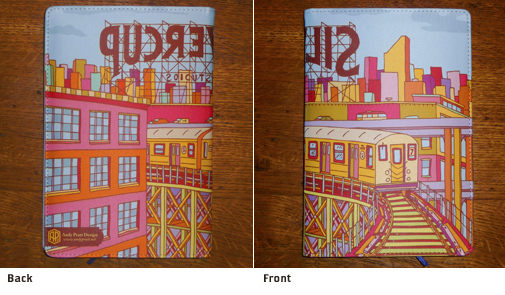
I’m looking forward to it myself and in anticipation I’m doing a shout-out of one vendor a week. This week my pick is: Andy Pratt Design. He makes journals, cards and other paper products and his work is fun and bold.

I love his new NYC journal (pictured at top of post) and I also  like his sympathy card (above) because, y’know, a good sympathy card is hard to find — and more and more I need them. The illustration on the card is lovely, I’m pretty sure there’s no weird message on the inside, and I plan to buy a few.

Call for Bike Lane After Fatal Accident

Transportation Alternatives is calling on the city to put a bike lane on Flatbush Avenue after  an 18-year-old cyclist was dragged and killed by a driver there on Wednesday.

“[A Flatbush Avenue bike lane] is definitely something worth serious consideration,” Transportation Alternatives spokesman Wiley Norvell told the Brooklyn Paper. “It’s a dangerous street for bicyclists, pedestrians and motorists as well. It would definitely be a design challenge, but that’s what we have traffic engineers for.”

Norvell said a bike lane stretching from the tip of the Manhattan Bridge in Downtown all the way to the Gil Hodges Memorial Bridge in Marine Park would not only help calm traffic, but “link the borough together” for bicyclists.

“It’s a critical corridor — if it was made safe for cycling, it would be utterly transformative,” he said.

The Food Coop on Barneys’ Planned Use of the Word Co-op

Here is the text of  the actual letter Joe Holtz, Manager of the Park Slope Food Coop, emailed to Brooklyn Paper. He sent it to me this morning with some regrets. He writes” ” I am not happy that they did not run the original letter since it states where we are coming from much better than the story they ran. I should have sent it to you that day.”

Letter to the Editor

April 6, 2010

Re: Your article:

April 1, 2010 / GO Brooklyn  / Carroll Gardens–Cobble Hill / Shopping

Hide the charge cards — Barneys is coming to Cobble Hill!

By Michèle De Meglio

The Brooklyn Paper

To the Editor:

Barney’s planned use of the word “co-op” in the name of their Atlantic Avenue store is a problem for us. We have been in the process of educating Brooklynites for 37 years about the benefits and meaning of the word “coop” as defined by the  NYS Cooperative Corporations Law and the International Principles Of Cooperation(www.ica.coop/coop/principles.html). Barney’s misuse of the word dilutes this effort and effectively undermines our business model and, for lack of a better concept, “brand.” The Park Slope Food Coop is highly recognized in Brooklyn and is inextricably linked to the word and concept of Coop. For Barney’s to use that same term in a manner that appears to be illegal under New York Law and run a business that is not in any fashion reflective of the real meaning of the word harms our cooperatively owned and democratically run business.

The specific reference in the law is: NYS Cooperative Corporations Law, Article 1 Section 3  (J) states “ The term “cooperative,”  “cooperation” or any abbreviation, variation or similitude thereof, shall not be used as or in a name except by a corporation defined in this chapter. Any cooperative corporation may sue for an injunction against such prohibited use of the term. A violation of this prohibition is a misdemeanor, punishable by a fine of not more than five hundred dollars.”

Furthermore, Article 1 Section 2 states “ It is the declared policy of this state, as one means of improving the economic welfare of its people, particularly those who are producers, marketers or consumers of food products, to encourage their effective organization in cooperative associations for the rendering of mutual help and service.”

This doesn’t describe Barney’s business model.

In cooperation,

Joe Holtz

General Manager

Park Slope Food Coop Inc

April 17: Owner of Park Slope Bookstore Selling Personal Book Collection

Catherine Bohne, owner of Park Slope’s famous Community Bookstore, is about to embark on a “Grand Adventure” (the details of which are under wraps for now). But before this great adventure can begin she must sell her personal book collection, what she describes as “2000 really good books.” She is also looking for a home for Jennie Lee, a Maine Coon cat, who comes, of course, with a trust fund for medical expenses.

Bohne’s lovely, whimsical style of writing speaks for itself. The date of the big sale is Saturday, April 17, from 10AM until…

Here’s the email I (and many others no doubt) received this morning:

Hi Everyone!

This Saturday, April 17th from about 10 am until we drop, I’ll be selling off most of my personal book collection (probably more than 2000 really good books) in one HumONGous stoep sale in front of my apartment at:

813 8th Avenue
[between 8th & 9th Sts]
Brooklyn, NY  11215

Everything must go!  And it’s gotta go that day, too!  Please come help me out by giving my books a good home!

And, while I’m at it:  I don’t know if there’s anyone out there who has a soft spot for gentle but chatty really old (18?) Maine Coon cats, but you could meet Jennie Lee, who’s looking for a more stable home than I’m providing at the moment.  She comes, of course, with a trust fund for medical expenses . . . .

And ALSO:  I don’t know if anyone needs handyman work done, but local Park Sloper and bookstore habituee Eric Rochow (www.handymaneric. com & gardenfork.tv) is a genius, has changed my life, rescued me and worked miracles — you can come look in my apartment if you want to see an example of his work . . .

Now . . . what is all this about?  Come to the stoop sale and I’ll tell you all about it!  (Well, I’ll tell you all about it soon, anyhow, BUT don’t have time right now . . . )  Don’t worry — the Bookstore’s fine.  I’m just having a Grand Adventure!

Much Love,
And see you soon,
Catherine

Driver Charged with Homicide in Death of Cyclist

The driver of the van that killed the Park Slope cyclist yesterday in Ditmas Park will face charges of criminally negligent homicide.

He also face charges of aggravated unlicensed operation of a vehicle, driving through a red light and speeding.

According the NY 1, the cyclist was traveling east on Beverly Road when he was struck on Flatbush Avenue around 9:30 a.m. A witness told NY 1: “He tried to get out of the way. But when he tried to turn the bike to avoid the van, the wheel just wobbled, and the van just hit him, his whole body. I saw his whole body went under the van, and he just dragged him all the way down here.”

Yesterday there were two other bike/vehicle accidents. Neither of those resulted in fatalities.

Park Sloper, 18, Killed in Bike Accident

Very sad news:

An 18-year-old cyclist from Park Slope was killed on Flatbush Avenue and Duryea Place in Ditmas Park on Wednesday morning when his bike was struck by a dollar van.

The NYPD said that the cyclist was a white male in his twenties. But I’ve heard from a source who knows the boy that he was an 18-year-old who attended PS 321 and Millenium High School and was currently a college freshman at CUNY.

He was traveling east on Duryea and the motorist was traveling north on Flatbush. The driver, a 28-year-old male, was charged with negligent homicide and other charges for driving without a license, speeding and going through a red light.

This is a terrible story.

April 16 & 18: Eleonor Bindman Plays Chopin at the Old Stone House

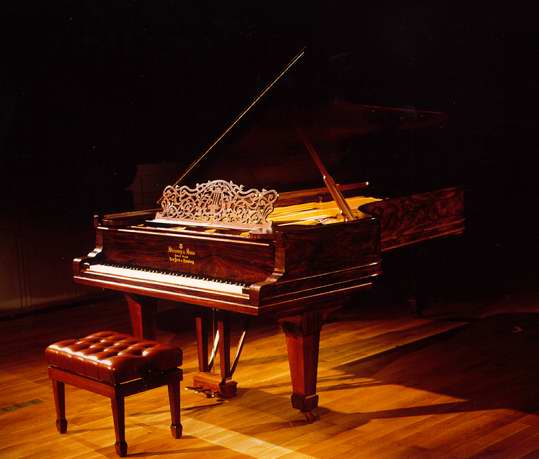
A  beautiful grand piano was donated to the Old Stone House and now they can present piano recitals like this one:

The Old Stone House presents a concert series to celebrate Chopin, Schumann and Liszt featuring pianist Eleonor Bindman. This is Part 1 of an ongoing series.

Friday, April 16, 2010 8 pm
Sunday, April 18, 2010 5 pm
Reception to Follow

Part One is a program featuring the works of Chopin. More info at theoldstonehouse.org

The piano pictured is NOT the one at the House.

Residential Sales Activity Up in Brooklyn

A quarterly report released yesterday by Prudential Douglas Elliman revealed that  residential sales activity is up in Brooklyn and Queens. They also said that there’s “a growing momentum in the high-end market.”

According to The Real Deal, which published an article about the report, “Brooklyn appears to be recovering faster than Queens, which has been devastated by high foreclosure rates.”

Tonight: Truth & Money (reading and discussion)

“The truth is that money is often a divisive influence in our lives. We keep our bank balances secret because we worry that being candid about our finances will expose us to judgment or ridicule—or worse, to accusations of greed or immorality. And this worry is not unfounded.”

–Jenny Offill and Elissa Schappell, Money Changes Everything (New York: Doubleday, 2007), p. xi

Brooklyn Reading Works:
The Truth and Money

On April 15, 2010, the Brooklyn Reading Works will present its monthly writers’ program on “tax day.” This happy accident, observed last summer in a casual conversation with John Guidry of the blog, Truth and Rocket Science resulted in the idea for a panel called “The Truth and Money,” a reading and Q & A with three authors whose work has taken on money in some significant way.

Our three panelists are:

Elissa Schappell, a Park Slope writer, the editor of “Hot Type” (the books column) for Vanity Fair, and Editor-at-large of the literary magazine Tin House. With Jenny Offill, Schappell edited Money Changes Everything, in which twenty-two writers reflect on the troublesome and joyful things that go along with acquiring, having, spending, and lacking money.

Jennifer Michael Hecht, a best-selling writer and poet whose work crosses fields of history, philosophy, and religious studies.  In The Happiness Myth, she looks at what’s not making us happy today, why we thought it would, and what these things really do for us instead.  Money—like so many things, it turns out—solves one problem only to beget others, to the extent that we spend a great deal of money today trying to replace the things that, in Hecht’s formulation, “money stole from us.”

Jason Kersten, a Park Slope writer who lives 200 feet from our venue and whose award-winning journalism has appeared in Rolling Stone, Men’s Journal, and Maxim.  In The Art of Making Money, Kersten traces the riveting, rollicking, roller coaster journey of a young man from Chicago who escaped poverty, for a while at least, after being apprenticed into counterfeiting by an Old World Master.

Please join us for the event at 8:00 p.m. on Thursday, April 15, 2010, at the Old Stone House in Washington Park, which is located on 5th Avenue in Park Slope, between 3rd and 4th Streets, behind the playground.

Over Here: NYC During WW II

Thanks to Leon Freilich for sending this over.

It’s been almost 65 years since New Yorkers celebrated the end of World War II, but a new book and accompanying film series give today’s residents a window into how life was “On the Town.”

The series, which begins at 6:30 p.m. April 13 at the Brooklyn Public Library, is based on the new book by Lorraine Diehl, “Over Here! New York City During World War II.”

The films, which continue each Tuesday through May 18, are discussed in the book and reflect life in the 1930s and into the war years, Diehl said.

“It was not too difficult for people to get on board and say, ‘We are the good guys, we have to win,’” she said.

An “all for one and one for all” attitude infused city life, Diehl said, and while New Yorkers faced privations, they were reasonably sure their homes wouldn’t be bombed. Londoners didn’t have that comfort, and New Yorkers understood that and acted accordingly, volunteering and showing soldiers on leave their appreciation.

But there was a dark side to New York, too. A pro-Nazi movement flourished in the German neighborhood of Yorkville, just as German Jews were flocking across the Atlantic to escape the horror overseas.

A quick look at the World War II-era films being screened

April 13: “All Through the Night” — It’s Humphrey Bogart versus Nazis in Gotham’s midst.

April 20: “The House on 92nd Street” — The film’s title is inspired by a Manhattan building that was home to the German-American Bund.

April 27: “Mr. Lucky” — Cary Grant in a film inspired by the “Bundles for Britain,” the knitting care packages New Yorkers sent to the British.

May 4: “Saboteur” — German spies set their sights on the Brooklyn Navy Yard

May 11: “The Clock” — Author Lorraine Diehl called this a valentine to the city. GI Robert Walker finds love with Judy Garland by the clock at Penn Station — the studio built a remarkable fascimile.

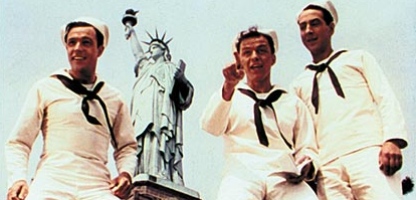
May 18: “On the Town” — Soldiers on leave whoop it up in a musical that celebrates New York’s wonders.

The series will be shown at the Dr. S. Stevan Dweck Center for Contemporary Culture at the Central Library, 10 Grand Army Plaza, in Prospect Heights. Take the Nos. 2/3 train to Grand Army Plaza

Discuss Truth & Money on Tax Day in Park Slope

“The truth is that money is often a divisive influence in our lives. We keep our bank balances secret because we worry that being candid about our finances will expose us to judgment or ridicule—or worse, to accusations of greed or immorality. And this worry is not unfounded.”

–Jenny Offill and Elissa Schappell, Money Changes Everything (New York: Doubleday, 2007), p. xi

Brooklyn Reading Works:
The Truth and Money

On April 15, 2010, the Brooklyn Reading Works will present its monthly writers’ program on “tax day.” This happy accident, observed last summer in a casual conversation with John Guidry of the blog, Truth and Rocket Science resulted in the idea for a panel called “The Truth and Money,” a reading and Q & A with three authors whose work has taken on money in some significant way.

Our three panelists are:

Elissa Schappell, a Park Slope writer, the editor of “Hot Type” (the books column) for Vanity Fair, and Editor-at-large of the literary magazine Tin House. With Jenny Offill, Schappell edited Money Changes Everything, in which twenty-two writers reflect on the troublesome and joyful things that go along with acquiring, having, spending, and lacking money.

Jennifer Michael Hecht, a best-selling writer and poet whose work crosses fields of history, philosophy, and religious studies.  In The Happiness Myth, she looks at what’s not making us happy today, why we thought it would, and what these things really do for us instead.  Money—like so many things, it turns out—solves one problem only to beget others, to the extent that we spend a great deal of money today trying to replace the things that, in Hecht’s formulation, “money stole from us.”

Jason Kersten, a Park Slope writer who lives 200 feet from our venue and whose award-winning journalism has appeared in Rolling Stone, Men’s Journal, and Maxim.  In The Art of Making Money, Kersten traces the riveting, rollicking, roller coaster journey of a young man from Chicago who escaped poverty, for a while at least, after being apprenticed into counterfeiting by an Old World Master.

Please join us for the event at 8:00 p.m. on Thursday, April 15, 2010, at the Old Stone House in Washington Park, which is located on 5th Avenue in Park Slope, between 3rd and 4th Streets, behind the playground.

Drinking With Divas – Indigo

This week’s Diva is Indigo Street, guitarist/singer/songwriter, who performs solo as well as with Shahzad Ismaily/101 Crustaceans/Landlady. Sarah met Indigo at the wonderful Walter Foods in Williamsburg for some lobster rolls and strong drinks.

Sarah: Tell me about your travels as a kid.  Why’d you run away from home at fifteen?

Indigo: I grew up in a fairly small, privileged part of the NYC arts community.  By the time I was twelve I’d danced at Lincoln Center and BAM, and even Madison Square Garden, so the stuff other people can’t wait to get to NY to do seemed sort of pedestrian to me.  I felt there was something else out there.  It was all very fantasy-based, very bohemian.  I went to Woodstock with some friends for the weekend.  I saw this guy walking through town barefoot, holding a guitar.  I think he was wearing a buckskin vest.  The next weekend I lied to my mother and told her I was going back to stay with friends.  She dropped me off and I just sat under a tree in the center of Woodstock and waited for the guy with the guitar.

Sarah: Did he show up?

Indigo: After an hour and a half, he walked up to me and sat down.  We ate ice cream for dinner and slept in the woods.  It was very romantic.  We hid out for a while in a half-built house that was just the wood frame, which is my favorite stage in the life of a house.  Crows perched on the window-less windowsills.  People kept telling me the police were walking around town with my picture, so on the fourth night we got someone to drive us over to her place. It was the middle of the night and she came down in her nightgown, and she was so cool.  I remember her asking if anyone wanted a cup of tea, which in retrospect is amazing, ’cause I had been so horrible and inconsiderate.

Sarah:  How long did you stay home?

Indigo: A few days, then I went back on the road.  I was at college briefly, but I got kicked out. You’re not supposed to be able to get kicked out of Simon’s Rock, but somehow I managed.  I moved back to NY at about 17.

Sarah: What’s more important to you: sex, drugs, or rock and roll?

Indigo: Ooh, that’s hard.   Right now I’m pretty much trying to abstain, so I’m liable to say sex.  And though occasional, my love of drugs is holding strong.   Altered states can facilitate great music making, and music making, itself, can produce some of the best altered states!  I guess that’s what formed that holy trinity in the first place.

Sarah: How do you get so many different sounds out of the guitar?

Indigo: Often, rock guitarists rely on pedals to get different sounds, but I feel fortunate in that I didn’t learn to use them earlier.  It made me learn to use the pick to vary the sound, different parts of my fingers, different articulations.  I used to have an apple corer I loved to play with.  It came in handy when I broke my wrist.

Sarah: What are the advantages of being self-taught as a musician?

Indigo: It makes invention easier. It more easily creates a musician who has their own voice rather than someone who is proficient but has trouble being original.  Being self-taught gives you idiosyncratic skills and gaps.  But that’s okay, because my main goal has always been to remove craft and artifice and get to the emotional heart of things.

Sarah: What does avant-garde mean to you?

Indigo:  That’s an interesting question.  I think that 30 years ago it just meant music that was pushing boundaries, music people hadn’t heard before.  New.  But now there’s a specific sound attached, even a specific location – the downtown scene, places like the Stone – this kind of sound that’s without a melody, often without a key.  I like a lot of that music, and as a guitarist enjoy playing that type of music, but as a writer that doesn’t feel like the truest expression for me.  I have to be careful not to worry about what is new for other people.  I try to create something that’s new for me, allowing it to feel as simple as possible and to include any and all influences.

Sarah: A lot of people are worried about shedding their influences.

Indigo: Not me.  I feel that imitation is possibly the most important part of being an artist.  Being an artist is a spiritual practice.  It’s devotional, and you find your devotion by connecting to the people who have come before you in your art form.  By paying careful attention to what moves you, circling around it, you circle around yourself, really.  That’s how you find the kernel of yourself.  I mean, I spent years in my bedroom imitating Ray Charles, learning his albums note for note.  There is no danger I’ll ever be accused of sounding like Ray Charles!  But when I listen to him and I feel like my head will explode, that’s who I am.  That love.

THE SAZERAC

After giving up heroin, Ray Charles had the same drink every day for the rest of his life: half a mug of black coffee with half a mug of Bols gin and two sugars.  We should pick and choose what we imitate.  Instead I recommend the Sazerac, the classic New Orleans whiskey drink, which they make exceptionally well at Walter.  This will put you in the mood for sex, drugs, rock and roll, and everything.

Mix in cocktail shaker filled with ice:

2 ounces rye (also delicious made with Cognac, or a mix of half-Cognac, half-rye)
1 barspoon simple syrup
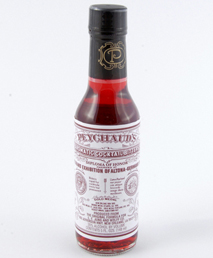
3 dashes Peychaud’s bitters

Stir for a long time.  Fill a short rocks glass with ice and drizzle a little absinthe over the ice.  Swirl it around, then discard ice and absinthe.  Strain the cocktail into the absinthe-rinsed glass.  Twist a lemon rind over the top, rub around rim, and drop in.

OTBKB Music: Lower East Side Doubleheader

As long as you don’t mind taking a brisk three block walk between shows, you can catch two fine acts tonight on the Lower East Side: Harper Blynn and Sasha DobsonNow I’ve Heard Everything has all the details here.

Also in News and Notes at  Now I’ve Heard Everything, links to two good accounts of SXSW 2010 (one translated from the original German), news about Steve Wynn and Robbie Fulks‘ thoughts about the philosophy of Alex Chilton.

–Eliot Wagner

Serving Park Slope and Beyond