
I checked out artist Caroline Woolard’s blog and found this writing about her Have a Seat bench project, which was part of a show at ConFlux: the annual NYC festival for contemporary psychogeography
where international artists, technologists, urban adventurers and the
public put investigations of everyday city life into practice on the
streets. The show is no longer open.
Have a Seat
is Caroline Woolard’s gesture towards reclaiming public space. It is a
platform for a new vantage point on the street. As seating bolted to no
parking signs in New York, Have a Seat offers rest and contemplation in
transitional spaces. Installed for ConFlux in Brooklyn from September
14-17, these temporary seats are the culmination of three years of
prototypes in New York and Rhode Island.In the city, the street
should be a destination in itself. Many people use the street to get
from one place to another, but it is an invaluable arena for immediate
interaction. Instead of walking to a park or other zone calculated for
relaxation, Have a Seat serves those people who want to pause amidst
action for a direct perspective on the momentum of the city. The seat
is a signal at the scale of the human body in a city of buildings that
consume space and light at the expense of pedestrians who are swept
forward by wind tunnels in the shadow of skyscrapers. Unlike monuments
that overpower people in scale and pretension, these wooden chairs wait
to be used by a single body on the street.Have a Seat makes
everyday environments strange, pushing for a moment to reevaluate the
monotony of consistent routine. Robert Musil writes, in The Man Without
Qualities:
“Everything we feel and do is somehow oriented
“lifeward,” and the least deviation away from this direction toward
something beyond is difficult or alarming. This is true even of the
simple act of walking: one lifts one’s center of gravity, pushes it
forward, and lets it drop again- and the slightest change, the merest
hint of shrinking from this letting-oneself0drop-into-the-future, or
even of stopping to wonder at it- and one can no longer stand upright!
Stopping to think is dangerous.”This project celebrates
individuals actively shaping shared space and the interactions in it.
It encourages pedestrians to stop and think. Although disembodied
conversations (Blackberry, cell phone, etc) and narrative accompaniment
(iPods) inevitably insulate individuals from this reality, I hope that
a symbol of rest amidst action allows some people to create immediate
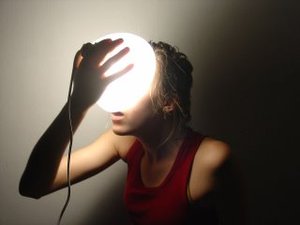
connection with the street.Pix: Light Molded to my Face by Caroline Woolard