
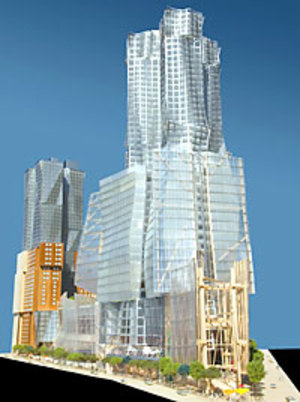
 In an article in Saturday’s New York Times, “What Will Be Left of Gehry’s Vision for Brooklyn,” Nicolai Ouroussoff, the paper’s chief architecture critic, packs a punch when he states his frustration with the current status of the Atlantic Yards Project.
Interestingly, it isn’t until the end of the article that he actually delivers the knock-out blow. I counted. It isn’t until paragraph 17 of the story that the article really kicks ass. In fact, if you only read the first 16 paragraphs you might think that the Times’ critic is just disappointed that the project isn’t turning out the way he hoped.
But it is in the 17th paragraph that Ouroussoff actually says something worth saying and it is something that the Times’ hasn’t said before. (I will be corrected if I am wrong, that’s for sure).
“No development at all would be preferable to building the design that is now on the table. What’s maddening is how few options opponents seem to have.
We could wage a public campaign to stop it. We could pray that Forest City Ratner comes up with more money. But given that the city approved the plan, we cannot prevent the developer from building the arena. Nor is there any way of preventing Forest City from selling off pieces of the property to other investors, who could then come up with any design they liked, as long as they abided by zoning and density guidelines.
Mr. Gehry, on the other hand, could walk away.”
These are strong words for the Times, which has been a strong supporter of Ratner and Gehry’s vision for the Atlantic Yards. The fact that Ouroussoff’s assertions are buried 16 paragraphs into the story is the real story for me.
The first many paragraphs of the story are about Ouroussoff original belief in the “greatness” of Gehry’s vision. But Ouroussoff admits that the project as now planned bears very little relation to the original promise that he saw in the project.
Maybe Ouroussoff had a little too much faith in Forest City Ratner and the realities of politics and development in this city.
“Designed by Frank Gehry, the project was a rare instance in which the architectural talent lined up for a New York project matched the financial muscle behind it. When it was unveiled in late 2003, it seemed to signal a genuine effort to raise the quality of large-scale development in a city still stinging from the planning failures at ground zero.”
Many Atlantic Yards detractors would certainly disagree with that. Others who were excited at the prospect of a Frank Gehry in Brooklyn might agree that Gehry brought some cache to what was basically a big, bad development.
While Ouroussoff admits that New York City has a terrible track record with development projects of this scale (i.e. Battery Park City. The MetroTech Center. Donald Trump’s Riverside South), he seemed to hold out hope that Gehry’s design coulda/woulda been of Rockefeller Center quality—despite Forest City Ratner’s architectural track record.
Hasn’t Ouroussoff ever been to the Atlantic or the Terminal Mall? That said, it was the Gehry name—and reputation—that seemed to give this Times writer so much confidence:
“If large-scale development is unavoidable, why not enlist serious talents like Mr. Gehry to come up with an alternative to the bottom-line proposals that have been the accepted norm for decades? Finally a big developer had turned to a legitimate architectural hero for help, rather than the usual corporate hacks.”
.
Many were lured by the promise of Gehry greatness. Myself included. But as the project evolved and was revealed to be the bloated mess that it is, faith even in the artfulness of Frank Gehry began to wane.
For me, Miss Brooklyn was one thing. But the residential towers were always a big mistake. Even Ouroussoff seems to agree with that assessment now.
“As it turned out, Mr. Gehry’s design revealed both the promise and the limits of that collaboration. The main residential blocks to the east of the arena lacked the architect’s signature ebullience. A series of mismatched towers along two sides of a central courtyard encompassing several blocks, they followed most of the usual planning rules: adhere to the street grid, pack in a good deal of retail along the street, add a dose of public space.”
Luckily, the Times didn’t “cut from the bottom” which is journalistic parlance for the practice of leaving the least important information for the end so that if the editor runs out of space, they can just cut from the “bottom” of the story.
It seems to me that Ouroussoff saved his boldest thoughts for last. Better late than never to acknowledge the false promises that were apparent to many all along. Still, it could of all hit the cutting room floor and maybe that’s why the Times’ put it there. Ouroussoff writes,
“But by pulling out he would be expressing a simple truth: At this point the Atlantic Yards development has nothing to do with the project that New Yorkers were promised. Nor does it rise to the standards Mr. Gehry has set for himself during a remarkable career.”
Drawing of Miss Brooklyn from 2006.
Louise, that was a brilliant posting.