
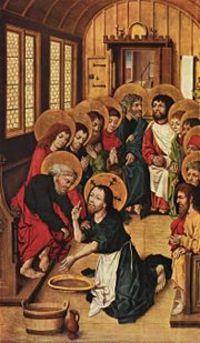
 Yesterday was Maundy Thursday, named for “The Maundy,” which is what medieval English monks called the Footwashing they did on Thursday of Holy Week.
According to Reverend Meeter of Old First Church in Park Slope, “the word “maundy” derives from the Latin word mandatum, for “commandment,” as they repeated in Latin the text from John’s Gospel, “a new commandment (mandatum novum) give I unto you, that ye love one another.””
Apropos of this, Meeter wrote the following homily for the small group, who showed up last night for the footwashing. I told Meeter that he should send it to the Op-Ed page of the New York Times or the letters section of the New Yorker. He thought it was too preachy.
I didn’t. I found it very interesting and unpreachy. Here’s an excerpt. The rest can be found on Meeter’s blog.
This week’s edition of the New Yorker has a column by Hendrik Herzberg on sex and politics and Eliot Spitzer, which disappointed me. Herzberg repeats the charge that America, compared to Europe, is overly concerned with the private sex lives of our politicians. He describes Bill Clinton’s dalliance with Monica Lewinski as “trivial.” He quotes the distinguished Professor Martha Nussbaum, that to accuse Spitzer of betraying the public trust is “laughable.”
Well, I agree that Clinton should not have been impeached, but I do wish he had resigned. We would expect the same of any preacher who did that with an intern. And it was right for Spitzer to resign. The underlying issue in both cases, I think, is not the sex, or the sex and the money, in Spitzer’s case. Sex and money are both expressions of the real issue, which is power.
We gave those people power. We put them in power when we elect them. We entrust them with more power than the rest of us, we want them to have power for our common good. We do the same thing with our generals and admirals, with our police chiefs and our building inspectors, we give them power over us. Power is not evil in itself, it’s only partly true that power corrupts, to leave it that power corrupts is to excuse the human heart, it is the human heart in its sinfulness that makes power corrupt. Jesus had power, he had lots of power, and he is not corrupt.
Classical literature tell us that power is drawn to hubris and to arrogance. In Latin terms, the terms of virtue, we can point to Spitzer’s arrogance. In Greek terms, the terms of drama, we can point to his hubris. For Spitzer it was a tragedy because it brought him down. For Clinton, the buffoonery of the congress made it not so much a comedy as a farce, and we the people got the worst of it. The whole nation has been besmirched. Can we turn to the literature of the gospels?
If we see virtue and comedy and tragedy more comprehensively in terms of love, the love of God for us and for the world, can we see a kind of power that is both holy and righteous?
Yes, on the cross, which we bring closer to ourselves in the Supper. There is also a secondary way, in the footwashing, which is why we are trying it tonight.
Not only because it’s in the Bible, and it’s a symbol that is rich and physical and not a little discomforting, not only because it’s regularly practiced by monastics and Mennonites and those Amish people who stunned us by how they responded to the death of their daughters in that school, but also because our vision of power needs to be refreshed. Jesus does that by framing power within servanthood and humility.
To wash the feet is servant’s work. Jesus shows us that he will give us power for our servanthood. But this is America, we don’t have servants here. This is a democracy, with liberty and equality. This servanthood is not about status, it’s about self-giving. And you cannot voluntarily wash someone else’s feet unless you are quite free…
With all due respect to Father Daniel, in this homily he seems obsessed with corruption regarding sexual behavior — as do many in the Episcopal Church, currently in schism over the issue of homosexuality, which a number of bishops and priests view as so corrupt that they are leaving TEC and joining foreign dioceses (i.e., Nigeria & the Southern Cone) with homophobic views.
He has no mention here of the incredibly widespread corruption of the Bush administration and how its corruption has had much more serious effects upon individual citizens and our society than any sexual behavior the minister is concerned with.
He is sorry President Clinton did not resign for a private sexual matter but says nothing about the evils done by President Bush, Vice President Cheney and others in the administration. As the bumper sticker goes, when Clinton lied, nobody died.
The good part of Father Daniel’s message at the end was obscured for me by his obsession with sexual behavior in the first half of the homily.
But then this obsession with sexual behavior seems sadly typical of many members of the clergy.