
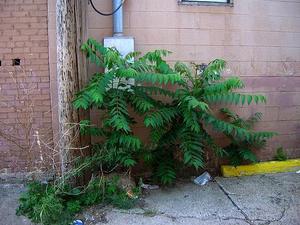
Here is the occasional feature from the Center for
the Urban Environment (CUE). In this submission Chiara Di Palma, Program Manager of
Urban Education at the Center for the Urban
Environment, takes a close look at a local favorite, “Tree of Heaven.”
The Tree of Heaven (Latin name Ailanthus) is perhaps
the most common tree species found in New York City. But despite its divine
name, is also the most notorious. An opportunist, like most New Yorkers, the
tree’s characteristics can be likened to the cockroach, rat or pigeon and
shares many things in common with them, namely its incredible ability to
survive in the most difficult of ecosystems. However,
unlike unwanted vermin, most New Yorkers see a hundred Tree of Heaven a day and
never think twice about them. Although incognito to most— for some, the
tree has a foul reputation, referred to as “Stinking Sumac,”
“Stink Tree,” “Ghetto Palm,” or more straight to
the point, “Tree from
Hell.”
The Tree of Heaven made its most famous debut in the
novel A Tree Grows in Brooklyn,
as a metaphor for the ability to thrive for the difficulties of growing up in
the borough. In the novel, the author admiringly describes the tree’s
tenacity but claims, in equal measure, “there are too many of
it.” Although once cultivated and hailed as a beautiful ornamental, like
all things ubiquitous, the Tree of Heaven is considered about as exotic as a
gold fish with the pesky habits of a weed.
In the mid to late 1700’s when
Chinese artistic style was popular throughout Europe, the tree was one of many
species brought west to add some Asian flare to ornamental gardens. It was
introduced into the U.S in 1784 for the same purpose. However, admiration was
soon lost as gardeners had to deal with the trees foul smell, its incredible
ability to spread its kin, and the impossibility of ridding it. The tree was
further spread as Asian immigrants brought it with them for medicinal purposes
to the western United States. Before it could be controlled, the tree quickly
spread itself across the country to every nook and cranny of the nation—
from the deserts of New Mexico, to the banks of the Mississippi and the streets
of New York City.
The Tree of Heaven is a short lived
but extremely fast growing tree. It can grow up to 6ft in just one year.
Because of its speed, it is quick to outrace other species for sunlight and
space. It has been known to grow out of sidewalk cracks, on the roofs of
buildings, and even in garbage piles. Once mature a single tree can produce as
many as 350,000 seeds a year. The seeds are dispersed by wind and fly far
distances propelled by their design. When the tree is cut down it can
re-sprout rapidly from the stump and is nearly impossible to eradicate without
herbicide. Its aggressive spread is no academic matter. The tree’s
ability to thrive is so intertwined with the demise of other species its
negative impact can’t be over looked. Furthermore, the tree
produces a toxin in its bark, leaves and seeds. The toxin produces a foul smell
and accumulates toxic poison in the soil, inhibiting the growth of other
species. The Tree of Heaven is also one of the most pollutant tolerant of
all tree species. It can tolerate high levels of pollutants such as salt, coal
tar, sulfur dioxide and ph levels as low as 4.0. These factors
combine to make the Tree of Heaven invasive and capable of out growing native
species, and of growing where few other trees dare to stand their ground. (In
its native China the Tree of Heaven has some 32 species of arthropods and
dozens of fungi that have a healthy relationship with the tree. In the United
States however, besides a few moths and a webworm it hosts the tree has little
redeeming value to wildlife. Thus when the tree pushes out native tree species
native animal species go along with them.)
But, to be fair, a
tree is still a tree and redeeming qualities aren’t hard to come by. The
Tree of Heaven helps to clean our air, lowers the heat island effect, shades
our blocks, and provides vegetation in areas hostile to other species. Look at
any vacant or abandoned lot in the city and there you will find it making
lemonade from lemons, and then you can decide, “Tree of Heaven” or
“Tree from Hell.”
Sources used:
Forest Service
Department of Agriculture: http://hort.ufl.edu/trees/AILALTA.pdf; Plant Conservation Alliance: http://www.nps.gov/plants/alien/fact/aial1.htm; USDA Forest Service: http://www.fs.fed.us/database/feis/plants/tree/ailalt/all.html